8 stages sit between a flowering cashew tree in the Tain District and the truck that carries the nuts to the exporter. This is the whole route, in order, with what happens at each stop and why it matters.
Every bag of raw cashew we buy began as a flower on a tree in the Tain District or Berekum. Between that flower and the exporter there are eight stages. Each has its own people, its own timing, and its own ways for quality to be won or lost.
Use the route beside the text to jump to any stage, or open a stage in the photo gallery to see the picture full size.
Stage 01 · The Orchard
Growing
Tain District & Berekum
Cashew trees take three to five years to mature. Once established they can keep producing for decades, which is why so many of our partner farms are multi-generational.
The cashew (Anacardium occidentale) is a hardy, drought-tolerant tree that does well in the warm, well-drained soils of Ghana's transition and savannah zones. Seedlings go in at the start of the rains and are spaced widely, so every tree gets sun and airflow. Crowded orchards yield less and are harder to keep healthy.
For the first few years the young trees need regular weeding, protection from bush fires and light pruning to build a strong frame. Many farmers intercrop with maize, cowpea or groundnut in that early period, which brings in income while the trees mature. After that, a well-kept tree keeps producing for decades, and orchards are often passed from one generation to the next.
Time to first harvest
3–5 years
Productive life
Decades
Where
Brong-Ahafo & Bono growing belt
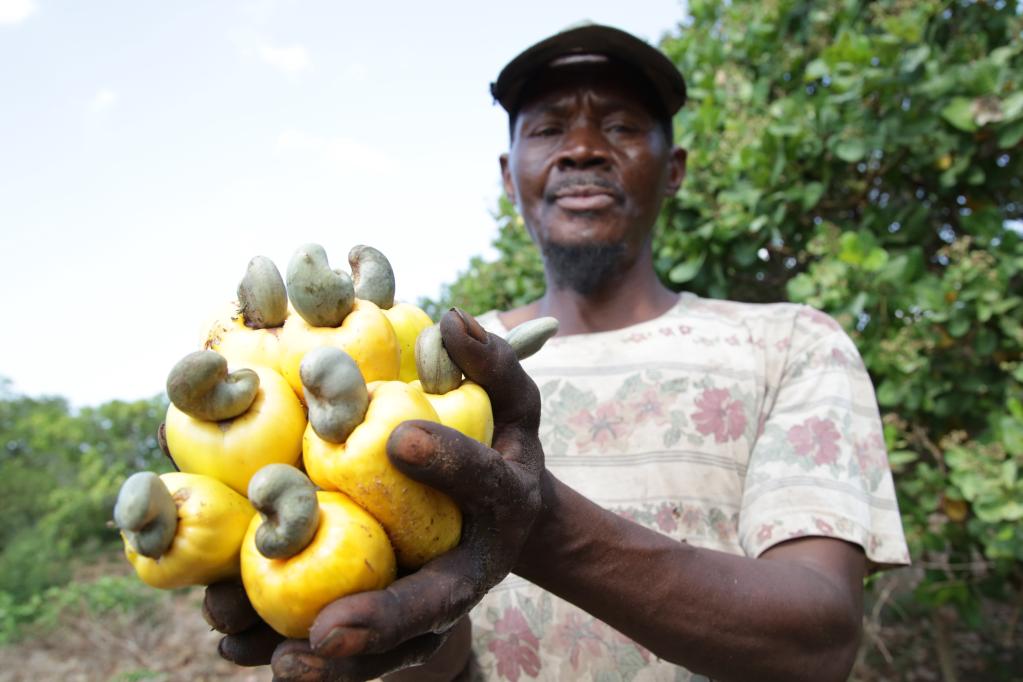
Ripe cashew apples — Abhishek Jacob, CC BY-SA 3.0, via Wikimedia Commons
Stage 02 · The Cashew Apple
Flowering & Fruiting
Peak season, Nov – Mar
Each tree flowers once a year. The nut grows on the outside of a soft, juicy 'apple' — it is the nut, not the fruit, that we buy and supply to exporters.
Trees flower once a year, at the start of the dry season, sending out large clusters of small pink-and-cream blossoms. Insects do the pollinating, and how many flowers actually set fruit depends on them, so keeping pollinators around the orchard helps the harvest.
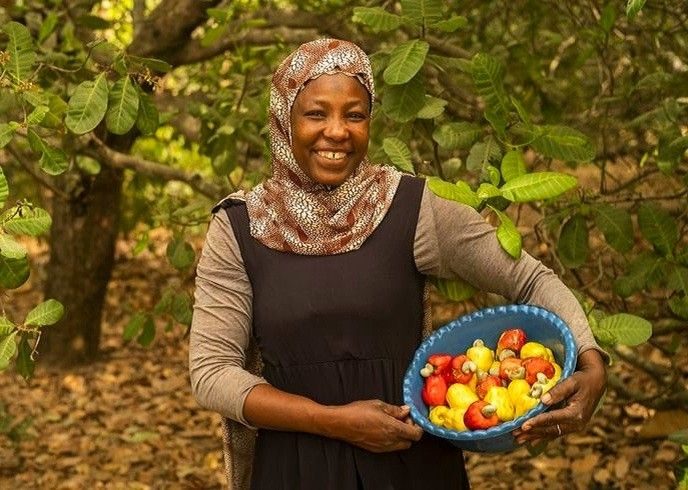
The cashew's fruit is unusual. The nut hangs outside the fruit, at the tip of a swollen, juicy 'apple' (botanically an accessory fruit). The nut forms first; the apple swells beneath it and ripens red, yellow or orange. The apple is edible and rich in vitamin C, but it bruises and spoils within a day, so it rarely travels far. The nut is the export crop.
Flowering
Once a year
Peak season
Nov – Mar
What we buy
The raw nut
Cashew nuts on the tree — Dr. Raju Kasambe, CC BY-SA 3.0, via Wikimedia Commons
Stage 03 · By Hand
Harvesting
Farms in the Bono Region
Ripe nuts are twisted free by hand and collected in woven baskets — a method that hasn't changed much in decades, because it still protects the shell best.
Nuts are ready once the apple has ripened and the nut has turned from green to grey-brown. Farmers twist ripe nuts free or gather the ones that have dropped, and they go back through the orchard every few days through the season rather than harvesting everything at once. That way each pass collects nuts at their peak.
The nut is separated from the apple straight away. Left together, the apple's sugars and moisture damage the shell and invite mould. Careful hand work protects the kernel inside: nuts that sit on damp ground or get attacked by pests lose value quickly. Harvested nuts go into woven baskets or breathable sacks, never sealed plastic, which traps moisture.
Method
By hand
Collected in
Woven baskets & breathable sacks
Picking rhythm
Every few days through the season
Photo: Unity Impex Buying
Stage 04 · Sun-Dried
Drying
Community drying yards & our store
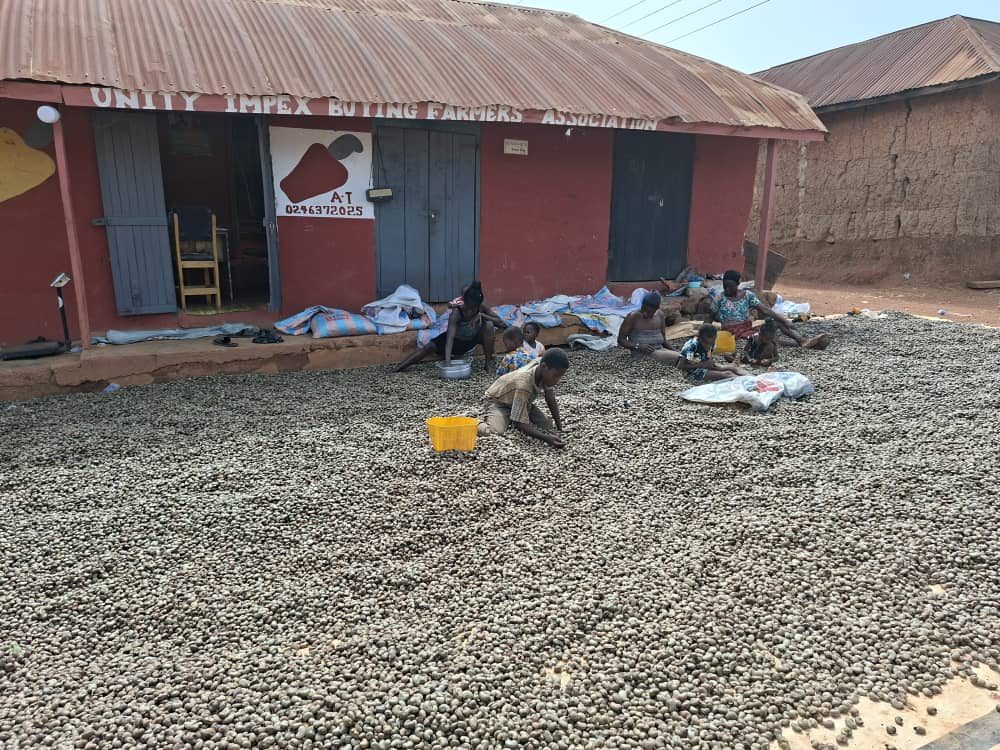
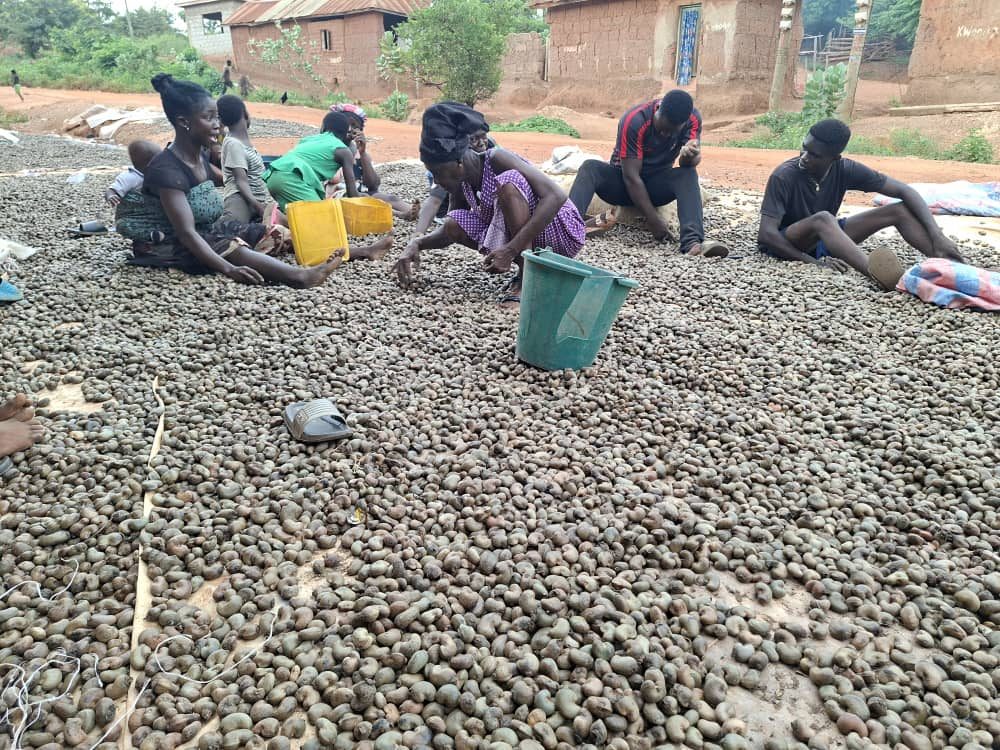
Raw nuts are spread out on mats and turned regularly over several days until moisture drops low enough for safe storage and transport.
Freshly harvested nuts hold too much moisture to store safely. They are spread in a thin layer on mats or raised drying racks, kept off bare soil, and turned regularly so they dry evenly. In good sun this takes several days.
Farmers check dryness by feel and by sound, since a dry nut rattles in its shell, and buying points use a moisture meter. Nuts that are too damp develop mould and off-flavours in storage, while over-dried nuts turn brittle and break. Once dry, the nuts are bagged and kept off the floor in a ventilated store until they move on to the processing yard.
Method
Sun-drying on mats or racks
Time
Several days
Target
Low, stable moisture (around 10% or less)
Photo: Unity Impex Buying
Stage 05 · Quality Check
Analysis & Classification
Unity Impex receiving point
Every lot is sampled at our receiving point: outturn (KOR) of 46 upwards, 180–190 nuts per kg and no more than 10% moisture.
When nuts arrive, a sample is taken and analysed. We check the outturn (KOR) — how much good kernel the nuts will give — which should be 46 upwards, and the nut count, which should be about 180–190 nuts per kg.
The sample is checked for spotted, immature, rotten and oily nuts and empty shells, and the moisture is measured. Nuts that meet the standard earn the standard price or better; nuts that fall short get a lower price.
Outturn (KOR)
46 upwards
Nut count
180–190 nuts per kg
Moisture
10% maximum
Photo: Unity Impex Buying
Stage 06 · At The Buying Point
Weighing & Bagging
Unity Impex buying points
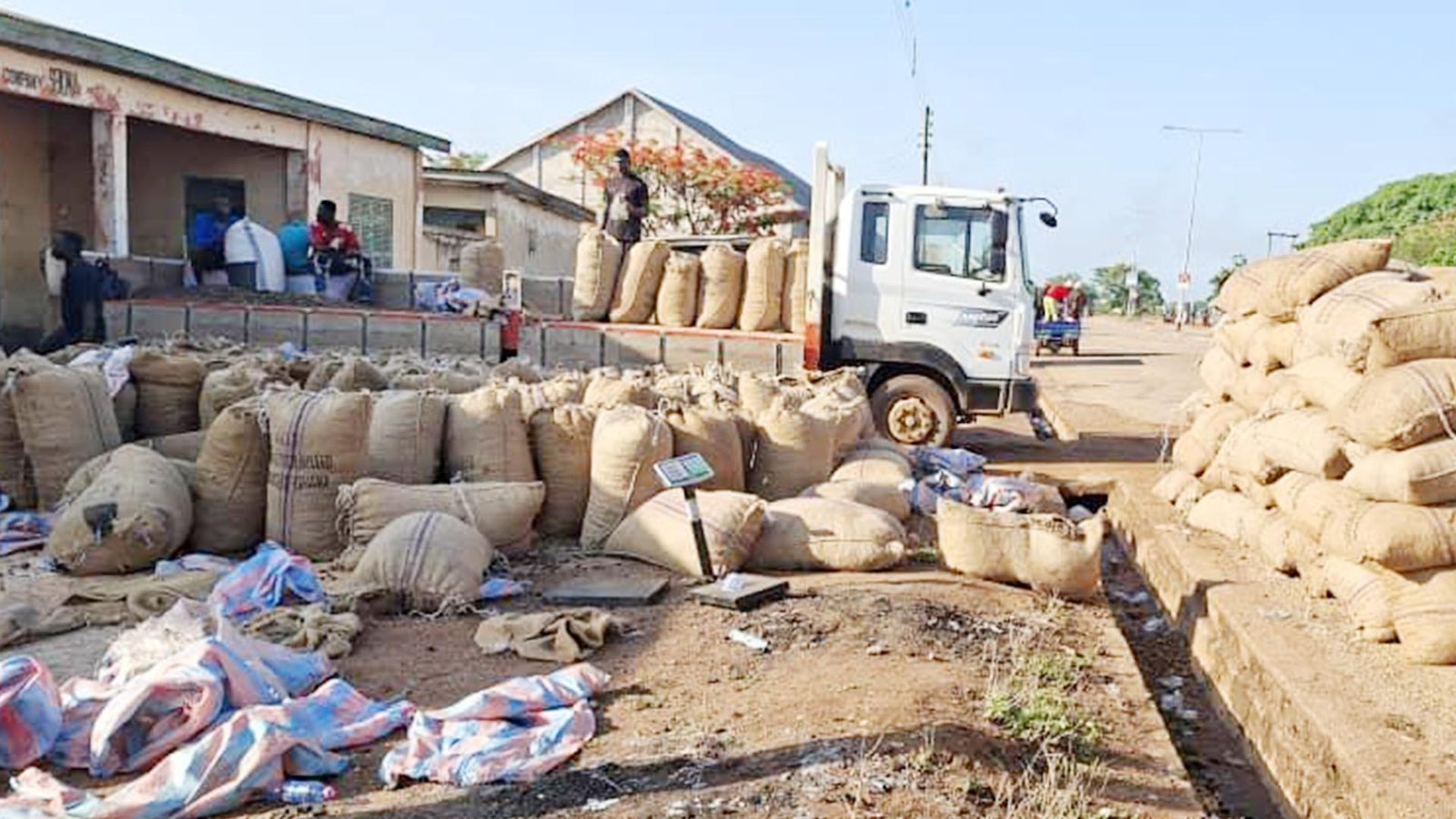
Nuts are weighed openly in front of the seller, the kilo deduction is recorded in the passbook, and the nuts are bagged in jute sacks.
At the buying point every bag is weighed in front of the seller and paid for at the TCDA minimum price or better.
During the main season 50 pesewas per kilo (GH₵50 per bag) is deducted and recorded in the farmer's passbook as kilo deduction savings. The nuts are then bagged in breathable jute sacks, ready for storage.
Weighed
Openly, in front of the seller
Kilo deduction
50p per kg / GH₵50 per bag
Sacks
Jute
Photo: Unity Impex Buying
Stage 07 · In Our Stores
Bulk Storage
Unity Impex stores
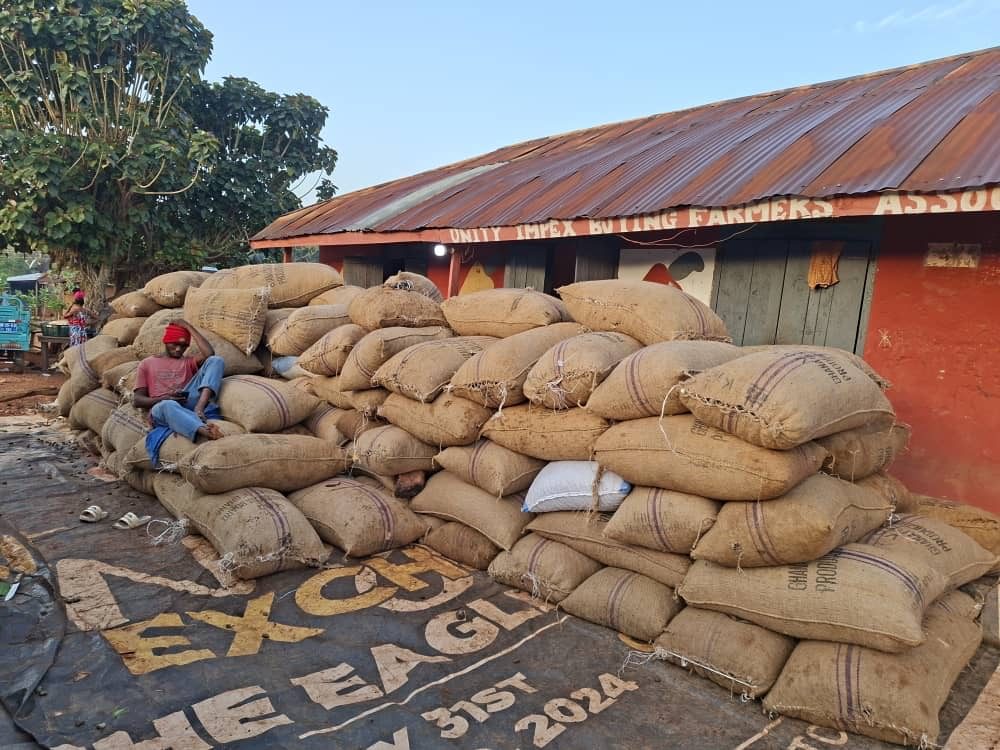
Dried, classified nuts are kept in our stores and in bulk storage, away from rain and damp, until they are ready for the exporter.
Once the nuts are dried and classified they go into storage. Our stores keep the bags off the ground and away from rain and damp, so the moisture stays low and the quality holds.
Lots are built up in bulk storage until there is enough to load for the exporter.
Kept
Dry, off the ground
Moisture
10% maximum
Ready for
Bulk loading
Photo: Unity Impex Buying
Stage 08 · Company Trucks
Loading For The Exporter
From our stores to the exporter
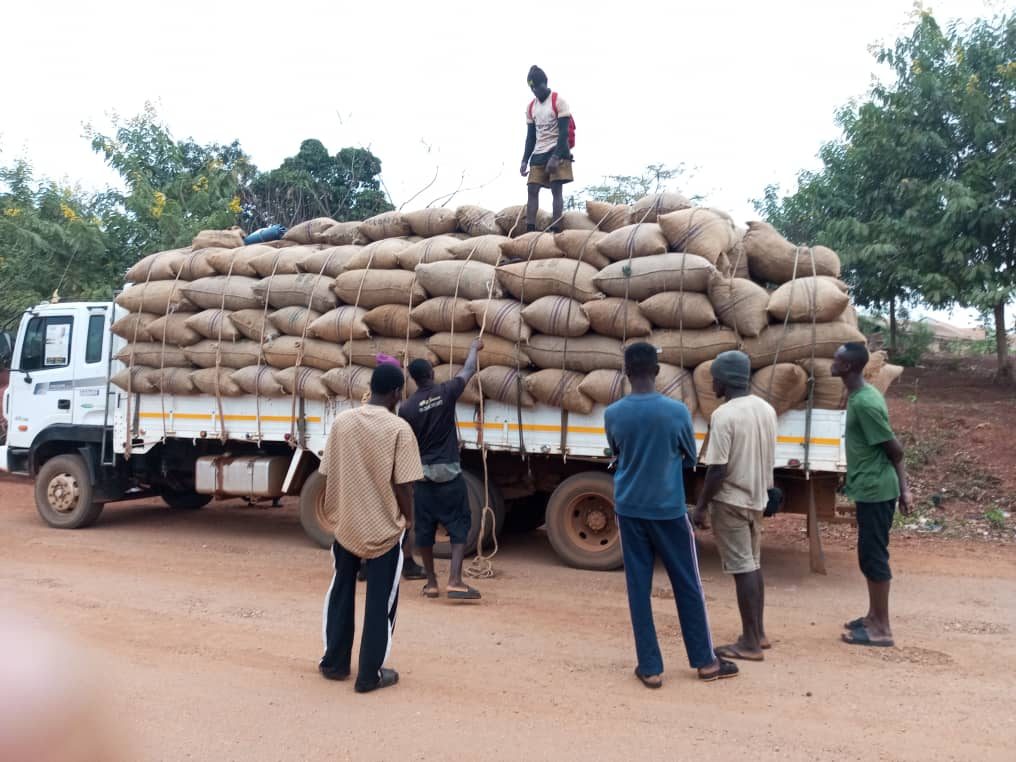
Our own trucks carry the bulk lots from our stores to the exporters — the last step before the cashew leaves Ghana.
Unity Impex Buying is a trader: we supply exporters. When a lot is ready, the bags are loaded onto our company trucks and carried to the exporter.
The same trucks pick up large quantities from farmers, aggregators and buyers during the season, so nuts move quickly from the farm gate to the exporter.
Transport
Company trucks
We supply
Exporters
Pick-ups
Large quantities from farmers & buyers
Have a harvest coming? Let's plan the rest of the route.
Whatever stage your batch is at, still on the tree or ready to load, our team at Kyekyewere, Seikwa can help you get it to the exporter.